My wife and I were at a wedding for a dear friend not long ago. It was a destination wedding in an unbelievable location, the kind that would begin a Netflix film about a family taking the trip of a lifetime, complete with champagne at check-in and swan-crafted bath towels. The phrase “spare no expense” comes to mind when I recall all the ways the weekend was designed, not merely as a ceremony, but as a long, unfolding experience of joy.
One of the things I most enjoy about any wedding celebration is the rehearsal dinner. The rehearsal dinner is the night when the weekend-long celebration takes the shape not of worship or a dance party but of storytelling, toasts, laughter, tears, and the speeches that pour forth love, affirmation, and wisdom onto the couple. They’re beautiful and wonderful and almost always go well, but this instance was a bit different.
It began as many do. We gathered. We sat. We ate, and then the time for toasts began. A few early toasts were shared, brief, lighthearted, warm. And then the mother of the bride rose to speak.
She shared beautifully about the love she felt for her daughter and the joy of welcoming a son-in-law into the family. Her words were everything a mother’s toast should be: full of tenderness, memory, delight, and blessing. The room was moved. Many were teary-eyed as they thanked her for her words with gentle applause.
And then she sat down, and silence fell over the group.
Who in the world could follow that? Who could stand up next and offer a goofy college story? Who could share a lightly-scripted encouragement without feeling like they were diminishing the beauty that had just been spoken?
One or two bridesmaids bravely tried, and their words were sweet, but compared to what the mother said, they felt small, almost out of place. Within minutes, the toasts ended. Many things were left unsaid. The elephant in the room sat on our hearts and minds, rooted in a desire to bless these two young people, loved and adored by all present. The bride and groom, who should have gone to bed drenched in affection, walked away with a sense that a special moment had been lost, love unshared, vulnerability hidden behind social niceties.
What went wrong? Why was the joy of the evening cut short? Is there a formula for a good celebration? One that would have us leaving saying, “That was just right.”
I was chatting with a friend recently, retelling the story of this wedding and wondering aloud why we left that night feeling a bit sad. And he very casually said something like, “Well, sure, you had lavishness and love, but no liturgy. And I thought to myself, “There it is. That’s the formula.”
In Revelation 19 we read of the wedding supper of the Lamb. The long-awaited union of Christ and his bride, the moment that all moments have been leading to, and guess what we find?
6 Then I heard what sounded like a great multitude, like the roar of rushing waters and like loud peals of thunder, shouting:
“Hallelujah!
For our Lord God Almighty reigns.
7 Let us rejoice and be glad
and give him glory!
For the wedding of the Lamb has come,
and his bride has made herself ready.
8 Fine linen, bright and clean,
was given her to wear.”
You guessed it, three ingredients: The love of God on display as he commits to marrying his bride, the church, lavishness in the garb of the bride and of the procession, and a liturgy of praise known and proclaimed by every person at the party!
These three ingredients, love, lavishness, and liturgy, dynamically stir us, vivifying the hearts of all those being celebrated and those participating in the joy of celebration.
Let’s explore each idea and how they dovetail to create something truly beautiful!
LOVE: The Animating Force of Celebration
Love is the animating force of beautiful celebration. It is the distinctive reason gathering is more than an event, a calendar item, a “To Do,” a social obligation. The love of someone, or some couple, or some group of folks, is what sparks the desire to lift ourselves above the ordinary rhythms of life to set aside time to celebrate!
I’m sure you’ve known the feeling. A birthday or a loved one is around the corner, or a co-worker is retiring after fruitful service at your side, and you want to do something special for them. Or perhaps a college friend is getting married (In the Bahamas) and love compels you to take off work, find a babysitter, and make the (Expensive) trip.
Love compels us to movement in the direction of celebration. Whether we are planning the event or offering our presence as a gift, we show up, not out of duty, but out of delight!
This sort of love is the foundation of a beautiful celebration!
Love is always the goal, the ideal, the guiding principle, the aim toward which every element of celebration points. We receive the command of love from Jesus Himself: “Love your neighbor as yourself.” Celebration is a heightened way to express and experience this kind of love.
It is love that brings people from miles away to see each other face to face. Love that keeps us thinking about someone long before the event, searching for a gift that shows we know them, that we “get” them. The gift itself is lovely, but even more beautiful is the double blessing of having the gift and having been thought of rightly.
It is love that compels us to toast, to bless, to speak aloud what is normally left unspoken. In speaking these affirmations, we set aside time to reflect on the loveliness of the person being honored. We labor to put pen to paper or fingertips to keyboard, shaping an ordered flow of encouragement, longing to tell a coherent story of how much we treasure this individual.
Perhaps a better way to say it is this: Celebrations take seriously the command to love your neighbor. They intentionally create spaces where love is the point and where joy and edification flow freely to all.
Love Expressed
In celebration, love takes form. It becomes visible through our presence, our gifts, and our words.
Presence
We honor those we love with our presence. We make time, hire babysitters, travel, pay for hotels, and leave our own homes to say to the beloved, “I want to see you face to face.”
During COVID, the ache of absence was felt by so many, especially those unable to celebrate or even say goodbye to dying loved ones. Presence is the first gift of love in celebration. To gather physically and be surrounded by embodied affection is something we crave. It’s something we long to have happen to us, yet are often too afraid to ask for, unsure whether we are worth the cost.
Gifts
Gifts enrich the experience of celebration. Sometimes the joy comes through practical generosity, wedding gifts that meet needs. The toaster and knives that start a home may seem utilitarian, yet meeting needs is a beautiful expression of love.
However, the gifts that move us most tend to carry a certain intimacy, a sense of knowing.
One of my friends is as good a gift-giver as you’ll find. She is deeply thoughtful and creative, and having her focus those gifts on you means you’ll feel deeply seen, known, and loved by whatever is under the wrapping paper. Those gifts become treasures.
One such treasure arrived after the birth of our firstborn son. We had struggled to get pregnant and were surrounded by a community praying for the realization of that hope. Just after Jack was born, we received a small vase designed to hold a single acorn. The box came with instructions on germinating the acorn and nurturing it into a sapling. The note attached described the pain of our journey, the beauty of our hope, and the vision of those seeds of prayer sprouting into the joy of this child, and now, the gift of watching Jack grow alongside that little tree. These sorts of gifts exemplify a beautiful sort of love!
Words
That gift was and is a treasure to me, but it would not have resonated so deeply without the note that came with it.
We all have an innate sense of the importance of words. God has given us this delightful faculty to communicate, making us far more capable than any other creature. Words are powerful. God spoke creation into being. Our words, too, can bring order out of chaos. With words, we cast vision for where we ought to go and what we ought to do.
We know their power to get things moving and done, and yet when it comes to love and encouragement, we often struggle to speak.
There is something profoundly humanizing about being spoken over, about hearing who you are in the eyes of those who know you and love you anyway. We crave words that name what is most beautiful about us. Such encouragements momentarily silence our insecurities and invite us to believe that the image of God truly shines in and through our lives.
Most of us, if we’re honest, don’t get enough of that. We move through life unsure of our goodness, unsure whether our love for others is being expressed in ways that can be received. We long for affirmation but rarely think to organize such moments for others.
Celebration is one of the few spaces where words of love flow freely, where affirmation and encouragement are the point. Perhaps we should do more of this while people are still around to hear all that we have to say.
Receiving love tends to be harder than giving it. It requires vulnerability, allowing oneself to be seen, heard, named, and honored.
Celebration trains us to receive love with open hands rather than deflect it with awkward jokes or self-deprecation. Celebrations make space for us to be open to enjoying the kindness shown to us. In receiving love, we proclaim to others that they, too, are worthy of such affection and attention.
Love is the beating heart. All of our celebratory acts flow from it. Without love, liturgy becomes sterile, and lavishness becomes indulgent. But with love, everything comes alive.
Love Alone?
There isn’t any real danger in love existing alone. At least not like the danger of the other two ingredients existing alone. The danger lies more in love not finding its expression.
There has likely been a time in your life when you had the best intentions of expressing and celebrating someone well, only to lose track of time and forget about the person or their special day altogether. There are few worse feelings, in my experience, than forgetting or missing an opportunity to properly express the love you truly feel for another in a beautiful and timely way.
Love is the heartbeat of celebration, but we will see that lavishness and liturgy can, for us, be the ways love takes shape and is offered to our loved ones!
Lavishness: The Embodied Goodness of the Feast
Lavishness is often the embodied dimension of celebration. The physical, tangible, taste-and-see sort of goodness that helps our bodies know: This is no ordinary moment.
We sometimes get embarrassed by the word lavishness. We associate it with indulgence, materialism, or overspending. But when governed by love, lavishness is the height of embodied delight.
Think of this from 1 John 3:1 – See what great love the Father has lavished on us, that we should be called children of God! And that is what we are!
When framed in the context of God’s love for us, the fear of its distortion fades into the background, and we can feel the generosity of spirit that flows through this word!
The Lavishness of the Feast
Lavishness at a celebration is not excess for its own sake. It is the art of setting the stage for a higher time to descend among us.
You’ve likely been to events where opulence was the goal. Where hosts sought to astonish guests with displays of wealth, hoping to leave the impression that they themselves were impressive. It’s the sort of lavishness you might have seen in your grandparents’ sitting room. The one with plastic on the sofa cushions “to protect them from people.” To which Jesus might have said, “Are sofas made for people, or people for sofas?”
That kind of lavishness shows off. It says, “Look at me! I’m why we’re all here!”
But that’s not the lavishness I mean.
The kind of lavishness I’m speaking of spares no expense for the sake of the celebration, not the sake of the self. This lavishness flows from a heart of hospitality, with the hope that every guest feels the evening was planned with them in mind. It makes you feel like you belong to the night. The money, time, and attention are lavished for the joy of the beloved, not toward spectacle.
This kind of lavishness shows up as good food and drink, and plenty of it. Beauty befitting the occasion and the beloved. Tables set with care and arranged for conversation and connection. Music that allows for talk during dinner and dancing afterward. Attire that honors the moment but relaxes as the party grows long.
Lavishness says, “Tonight is unique, a gift, especially planned for this appointed time.”
I’ll never forget a wedding I attended in Texas one Spring with my wife and family. The ceremony was to be held in a field near an old barn on property belonging to the family. As we arrived and were ushered to our seats, the spectacle of 10,000 full-grown sunflowers captivated our attention! “No wonder they chose this spot,” I thought, “This field of flowers is spectacular!” And it was true, but the story behind those flowers was even more wonderful!
The father of the groom knew the bride loved Sunflowers, and in preparation for the wedding, he cleared the field of what had been growing there, some basic crop, and took a chance on planting Sunflowers in their place. The Lord blessed his efforts, and the flowers were in full bloom for the ceremony, creating the most beautiful and personal ceremony I have ever witnessed.
This, my friends, is what lavishness can be! Thoughtfulness and love on display in the form of a beautiful gift to those being celebrated!
We couldn’t and shouldn’t do things like this every night or all the time, but there are higher times that warrant such effort and expense. Celebrations like the one I mention are, for us, a glimmer of hope, love, and glory in a world that is often hard, painful, mundane, and wearisome.
Lavishness invites a feast when so much of life feels like a fast. It reminds us that celebration is good and right, and that we belong in such spaces!
Lavishness honors our creatureliness. We are embodied souls living in a world of taste, touch, sound, and smell. Celebration invites all the senses to join the chorus of delight.
Biblical Lavishness
Scripture is surprisingly lavish in its descriptions of feasting.
Jesus’ first miracle at Cana kept the wedding going, elevating the joy of the celebration with the finest wine. The prodigal’s return sparked the preparation of the fattened calf and the celebration of the whole household. Jesus’ worth was honored with a priceless jar of nard (Mark 14). Then, around the Passover table, He gave His disciples their final lesson in redemption, inviting them into a new covenant and a renewed hope. And one day, we will arrive at that great feast from Revelation 19, the Wedding Supper of the Lamb, to be celebrated and joined to our groom for all eternity!
God is not stingy with celebration. He invented it.
Our embodied nature is not accidental, and our capacity to experience delight is not a bug in the system. It is a grace. The curse did not kill our ability to enjoy goodness. Our bodies are the way we “taste and see that the Lord is good.”
Lavishness Alone
Lavishness becomes a curse when detached from love. If lavishness alone were enough, the wealthy would be whole. But fullness does not come from filling one’s belly, satisfying every craving, or endlessly spending on spectacles, gadgets, or experiences. Without love, lavishness collapses inward into indulgence, comparison, and exclusion. Sensuality without soul. What seems like a bright space of delight becomes a black hole of selfishness.
Beware of lavishness without love, for man cannot live by bread alone (even if it’s a fancy baguette).
But under the rule of love, lavishness becomes generosity, an embodied grace. Together we taste and see that the Lord is good.
LITURGY: The Rhythm That Makes Room for Joy
A final, most important piece of this puzzle.
Liturgy is the ordering dimension of celebration, not merely “church service liturgy” (though that is certainly connected), but the simple idea of structured, intentional, ordered action that invites participation.
Recall the story I opened with. That rehearsal dinner had both love and lavishness in abundance, but it lacked a liturgy, a rhythm, or order that could invite each of us into a shared expression of the love in our hearts. This is the element we most often overlook. Not because we are careless, but because we tend to believe these things should “just happen naturally.” Or worse, that if something is organized, it will lose its authenticity.
Allow me to gently argue you out of those beliefs.
Liturgy is never meant to strip an experience of authenticity; it exists to give authenticity room to breathe. It helps us know when, how, and to what degree the heart is invited to be expressed. Think of the ways you inhabit a worship space. In any public gathering, clarity is kindness.
A few weeks ago, I was performing a baptism for a young family. During the congregational charge, I said:
“Will you stand with this family in love and support as they seek to raise this child in the ways of Jesus? If so, say, ‘We will.’”
Stand or say? Which was it?
Half the congregation rose to their feet, and the other half stayed seated and simply declared, “We will!” There was no lack of love for the family; I had simply muddled the liturgy, making their participation more confusing than clear.
All large gatherings need a liturgy. The people in attendance need to know what is happening and how they are being invited to inhabit the space. One translation or meaning of the word liturgy is “the work of the people.” Celebration is no different.
At a birthday, the liturgy answers:
- When do we sing?
- When do we blow out the candles?
- When do we open presents?
- When can we speak words of encouragement to the person being celebrated?
- When do we eat the cake?
At a wedding reception, the liturgy answers:
- When do the bride and groom dance?
- When do the groomsmen reveal their slightly-too-long choreographed routine?
- If we clink glasses, do they kiss?
- WHEN DO WE EAT CAKE?
Liturgy gently inhibits certain elements of an experience so that it can invite other elements to be seen and savored more fully. It establishes the rules of the game so everyone can play freely, knowing what is in and out of bounds.
Liturgy creates space for high-energy celebration, dancing, singing, and revelry, while also quieting the room so the heartfelt words of a father can be heard by all as he blesses his daughter and new son-in-law on their first night as a married couple.
Liturgy is the skeleton of the event, giving the celebration its proper shape. But the body is filled out with the goodness and beauty of love and lavishness. At its best, liturgy doesn’t restrict love or lavishness it amplifies both. The more thoughtful, but not controlling, we are about how people may express their love to the beloved, the greater the chance that love will be expressed to the fullest.
Liturgy Alone
Liturgy without love or lavishness, however, collapses into forced participation, heartless presence, and empty praise. This is the sort of experience where you are asked to participate even when your heart is not aligned with the content of the liturgy.
You may have participated in a forced experience of liturgy from time to time and felt your heart drop a bit, hoping the moment would pass quickly. Or maybe it is during an end-of-year company celebration where everyone is asked to acknowledge a co-worker who has done “exceedingly well,” when you know they tend to act selfishly and manipulate the optics of a project to receive the lion’s share of credit from something you all participate in. Perhaps you’ve seen it happen at a restaurant when the waiters come to do the song and dance of the happy birthday song and meet the task with the excitement of going to the dentist.
Liturgy without love forces a perfunctory participation but feels very little like the fullness of celebration.
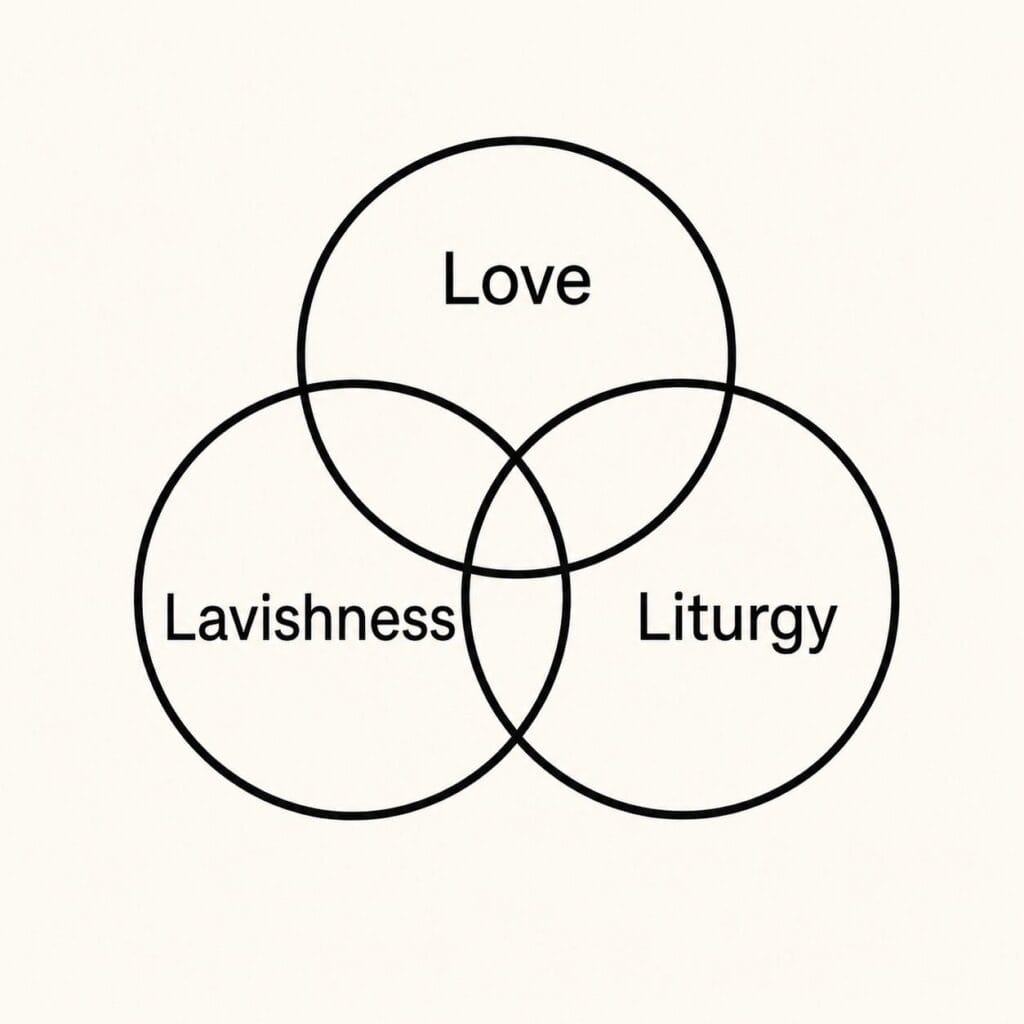
THE OVERLAPPING VENN: Where Celebration Reaches Its Joy
Now we come to the beauty of the overlap. The very heart of the anatomy. Celebration, held in three parts and converging into one whole, becomes something luminous, something deeply joyful. Each element feeds the others. Each one refines what the others bring. And when they meet, something holy happens.
Love + lavishnessness
Lavishness without love becomes indulgence in sensuality.
Love without lavishness may not make it from your heart to theirs.
But when love and lavishness meet, they create an embodied generosity, the lived experience of hospitality. These two together set tables with flowers and name cards, lay out fancy napkins, and place all the forks and spoons with almost ceremonial precision. They are the ones who dim the lights just so, who light candles and craft playlists, who say through every detail, “We knew you were coming, and we are so glad you’re here.”
In this pairing, the joy of love flows naturally into the sacrifice of time, money, and attention. The feast becomes a tangible proclamation: these people matter. Their story matters. This night stands apart because it celebrates the beloved. Lavishness becomes the language love speaks through beauty, and love becomes the soul that keeps lavishness from curving in on itself. Together they form a generosity you can taste, touch, smell, and see.
Love + Liturgy
Love without liturgy may get overlooked in the midst of a party.
Liturgy without love becomes heartless, perfunctory participation.
Love prefers intimacy. It thrives in whispers, quiet confessions, handwritten notes, and late-night conversations. But liturgy draws love into the open so the whole community can participate. When love and liturgy meet, the celebration gains a rhythm that makes room for everyone, the loud and the quiet, the outgoing and the reserved, the life-of-the-party uncle and the introverted friend who still has something beautiful to say.
These two together create the rise and fall of the evening: the toasts and the silence, the dancing and the listening, the blessing and the laughter. They gently guide the room into a holistic expression of joy. Simply being together is not enough to fully express the love of our hearts. But when liturgy joins hands with love, suddenly we are free to sing, dance, feast, pray, toast, laugh, cry, and bless. Liturgy becomes love’s megaphone — not amplifying the noise, but the meaning.
Lavishnessness + Liturgy
Lavishness without liturgy throws parties but forgets to make toasts.
Liturgy without lavishness can give us words to say, but not glasses to clink.
When lavishness and liturgy work in tandem, time becomes sacred. There is a structure for the toasts and full glasses of champagne ready to clink. There is space for dancing and a band talented enough to electrify the room. There is thought behind the seating and plates full of steak and greens set before each guest.
There is a rhythm: the opening, the feast, the blessing, the dancing, the send-off. Sparklers held high as the bride and groom run through them, radiant in the glow of their community’s joy.
Liturgy gives moments their shape; lavishness gives them their shine. Together they lift the gathering above the ordinary, turning time itself into a gift, something to savor, something to remember, something almost sacramental.
The Culmination: A Foretaste of Glory
When Love, Lavishness, and Liturgy finally converge, celebration becomes something far greater than the sum of its parts. It becomes a foretaste, a small glimpse of the Wedding Supper of the Lamb (Rev 19).
In their overlap, love gains a body, lavishness gains a soul, and liturgy gains a heartbeat. The celebration, whether small or grand, becomes a living parable of what human community was always meant to be. We taste and see that life is more than the grind, more than the sorrow, more than the long monotony of days that blur into each other.
The best celebrations allow us to set aside the heaviness of daily rhythms and remember that there is still beauty, goodness, and love in this world. On these nights, we hold up a candle of hope in the darkness and boldly proclaim to ourselves and to others that love, joy, and delight need not be scarce.
These celebrations serve as rehearsals for the joys promised by Jesus at the end of all things.
Because at the center of our faith is a wedding.
At the conclusion of Scripture is a feast.
And at the heart of the Christian hope is a celebration.
The prophets spoke of it. Jesus hinted at it in His parables and inaugurated it at His table. The Church embodies it in communion and in the everyday rhythms of love and hospitality. And Revelation brings the story to its climax with the announcement that history is moving toward the moment when God Himself hosts the greatest celebration the world has ever known, his very own wedding to his most beautiful bride.
There, Love, lavishness, and Liturgy will find their highest and proper places in the communion of Christ.
What we practice now in our feasts, our weddings, our birthdays, our baptisms, our toasts and tears and laughter, these are not mere niceties. They are rehearsals. They are the small stage on which we learn to receive love, give love, honor one another, and delight in the gifts God has woven into the world.
So perhaps we should do it more and do it better!
Let’s not restrict ourselves to the “big three” (births, weddings, funerals) as the only spaces for celebration. Let’s find reasons to celebrate and express the love we have for the people we treasure. Let’s not wait for their funerals to speak the gratitude and affection that would lift their hearts and renew their vision of themselves. Let’s do it now, and do it often.
Sometimes this may be as simple as offering timely, encouraging words. But what if we embraced a more regular cadence of celebration and blessing? What if our communities became marked by the rhythm of noticing, honoring, and delighting in one another?
What might that look like?
For years now, I’ve said I was going to begin doing this for friends on their birthdays, to take the lead in making space where all three elements of celebration are present. Love and lavishness aren’t hard to pull off; it’s the organizing of a liturgy, the preparing of people to participate, that proves harder.
But imagine an evening that begins like any other birthday dinner. You arrive at the same familiar scene: the usual friends, delicious food, cocktails, and small talk. Then your best friend stands and says something like:
“We all know why we’re here, to celebrate another trip around the sun for our dear ole Bob. Normally, we’d rush to candles and cake and offer a few flimsy jokes about how unbelievably old he is. But tonight we’re doing something different.
Bob, you know you mean so much to each of us. We didn’t want another year to pass without telling you the ways we see the love and light of Christ in you. At the risk of making you uncomfortable with our affection, a few of us would like to share some brief words about who you are to us, the beauty we see in you, and the hope we have for you in the year ahead.”
The night unfolds with laughter and tears. You leave feeling as though you’ve received the gift you truly wanted but would never have known how to ask for. It moves you. To have been thought of, spoken to, and honored with words of affirmation and delight.
It might even change you. It might lift you from some hidden insecurity. It might turn you toward Jesus in gratitude for all He is doing in your life. It might lead you to repentance, or renew your courage to live into the beauty your friends have seen in you.
Celebration reminds us that love and encouragement need not be scarce.
Let’s be people who keep feasting on the best stuff, in a world that is unknowingly fasting from the fullness of Biblical celebrations!